1990s Fashion Trends: The Complete Guide to ’90s Style and Culture
Introduction
The 1990s fashion trends emerged from a cultural reset. The 1980s ended with a stock market crash and a global recession, and fashion responded by abandoning excess for something more honest. Grunge, minimalism, hip-hop style, and supermodel glamour all competed for attention. This guide breaks down every major 1990s fashion trend, explains why each one mattered, and shows you how to recognize the era’s influence today.
What Were the Defining 1990s Fashion Trends?
The 1990s produced more distinct fashion movements than almost any other decade. The decade opened with the high glamour of supermodels, shifted hard into grunge and minimalism, and closed with the playful, futuristic energy of Y2K style. Each trend reflected a different response to the cultural moment.
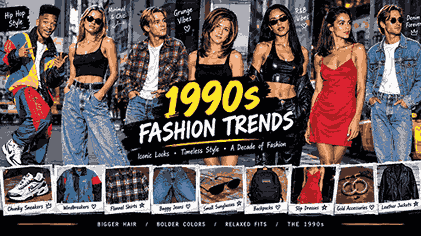
Here are the 1990s fashion trends that defined the decade:
- Grunge — flannel, worn jeans, band tees, and Doc Martens
- Minimalism — clean lines, neutral tones, and understated luxury
- Hip-hop style — baggy jeans, oversized jackets, and streetwear
- Supermodel glamour — Versace, high fashion, and larger-than-life personalities
- Slip dresses — silky, simple, and worn alone or layered
- Logomania — visible designer branding on everything
- Deconstruction — unfinished, avant-garde garments with raw edges
- Y2K futurism — metallic fabrics, cyber aesthetics, and tech-inspired looks
The Grunge Revolution: How Seattle Changed Fashion Forever
Grunge started in Seattle’s music scene in the late 1980s and exploded into a global fashion force by the early 1990s. The look was built on mismatched, layered, and intentionally worn clothing — flannel shirts, baggy jeans, and heavy boots. It was a direct rejection of 1980s polish.
Marc Jacobs brought grunge to the runway in 1993 with his Perry Ellis collection. He sent models out in flannel skirts, baggy pants, and skull caps. The fashion establishment fired him for it. Two years later, everyone was dressing like him.
What Made Grunge Fashion Different?
- It was anti-fashion. Grunge rejected the idea that clothes needed to be new or expensive.
- It was gender-fluid. Both men and women wore the same oversized flannels, ripped jeans, and boots.
- It valued authenticity over perfection. Worn-out and second-hand clothing became desirable.
Kate Moss became the face of this moment. Her waifish look replaced the athletic supermodel body that dominated the late 1980s. She represented something fragile and real that grunge fashion needed.
Minimalism: The Quiet Power of 1990s Fashion Trends
Minimalism became the dominant fashion language of the mid-1990s. Designers like Calvin Klein, Jil Sander, and Helmut Lang stripped clothing down to its essentials: clean silhouettes, neutral colors, and impeccable tailoring.
The economic recession made visible wealth feel tasteless. Minimalism offered elegance without flash. A simple slip dress, a well-cut blazer, and a plain white t-shirt could be more powerful than any sequined gown.
Key Minimalist Designers and Their Contributions
| Designer | Signature Contribution | Era |
| Calvin Klein | Slip dresses, clean denim, underwear-as-outerwear | Early-mid 1990s |
| Jil Sander | Precision tailoring, neutral palettes | Early-mid 1990s |
| Helmut Lang | Deconstructed minimalism, denim, tech fabrics | Mid-late 1990s |
| Prada | Intellectual minimalism, nylon bags, ugly-chic | Mid-late 1990s |
Helmut Lang also pioneered streaming fashion shows online, making him one of the first designers to embrace digital technology.
Hip-Hop Fashion and Streetwear Take Over
Hip-hop fashion moved from the margins to the mainstream during the 1990s. Baggy jeans, oversized jackets, and brand-name athletic wear became status symbols. Artists like TLC, Aaliyah, and Tupac Shakur turned street style into pop culture currency.
Cross Colours, FUBU, and Karl Kani built fashion brands specifically for hip-hop culture. Tommy Hilfiger and Polo Ralph Lauren became aspirational labels within urban communities. The baggy silhouette defined an entire generation’s visual identity.
What Made Hip-Hop Style So Influential?
- It was aspirational. Brand visibility mattered — the bigger the logo, the better.
- It was comfortable and practical. Baggy clothes suited dancing, skating, and daily life.
- It crossed racial and class lines. Suburban teenagers adopted hip-hop style almost immediately.
Supermodels and the Glamour of Early 1990s Fashion
The early 1990s belonged to the supermodels. Linda Evangelista, Cindy Crawford, Naomi Campbell, and Christy Turlington became household names. They walked Versace’s 1991 show arm in arm, and the moment became fashion history.
Gianni Versace designed for these women specifically. His clothes celebrated the body with bold prints, high slits, and aggressive sexuality. The supermodel era was short — it faded by the mid-1990s as grunge and minimalism took hold — but its impact on celebrity culture lasted for decades.
The Slip Dress: 1990s Fashion Trends at Their Most Elegant
The slip dress became the defining minimalist garment of the 1990s. It was simple, silky, and often bias-cut. Women wore them alone for evening events or layered over white t-shirts for daytime.
Kate Moss wore a sheer silver slip dress to a 1993 Elite Model Agency party and created one of the decade’s most copied looks. The dress worked because it was effortless. It required no accessories, no structure, and no fuss.
Deconstruction and Avant-Garde Fashion in the 1990s
Deconstruction challenged everything about traditional clothing construction. Designers like Martin Margiela and Rei Kawakubo of Comme des Garçons created garments that looked unfinished, torn apart, or reassembled.
Margiela’s work was particularly radical. He exposed seams, left hems raw, and used recycled materials. His shows featured models with obscured faces and unconventional staging. Deconstruction influenced everything from high fashion to streetwear.
Logomania: When Brands Became the Statement
The 1990s saw designer logos become the main event. Gucci, Louis Vuitton, and Fendi made their monograms and branding central to their designs. Tom Ford’s Gucci revival in 1995 made logomania sexy and desirable again.
Logomania worked because it was visible status. A Gucci belt or a Louis Vuitton bag communicated wealth instantly. This trend faded in the late 1990s as minimalism returned, but it laid the groundwork for today’s logo-driven culture.
Y2K Fashion: The 1990s Fashion Trends That Looked Forward
As the millennium approached, fashion turned futuristic. Metallic fabrics, cyber aesthetics, and technology-inspired designs defined Y2K fashion. Jean Paul Gaultier and other designers explored what clothing might look like in a digital age.
The Y2K aesthetic also embraced playful nostalgia. Low-rise jeans, crop tops, and bold accessories became staples. Britney Spears’ “…Baby One More Time” video in 1998 made the sexy schoolgirl look a global phenomenon.
How 1990s Fashion Trends Shaped Modern Style
The 1990s influence is everywhere today. Gen Z has revived slip dresses, baggy jeans, and flannel. Vintage stores can’t keep 1990s pieces in stock. Brands like Calvin Klein and Tommy Hilfiger have rebuilt their identities around their 1990s archives.
Why Does 1990s Fashion Keep Coming Back?
- It was authentic. The decade valued realness over perfection.
- It was diverse. Grunge, hip-hop, minimalism, and glamour all coexisted.
- It was comfortable. Oversized fits and simple silhouettes feel good to wear.
- It was aspirational without being unattainable. You could thrift a grunge look or save for a logo bag.
Key Designers Who Defined 1990s Fashion Trends
| Designer | Key Contribution | Defining 1990s Fashion Trend |
| Marc Jacobs | Grunge collection for Perry Ellis (1993) | Grunge |
| Calvin Klein | Minimalist slip dresses and clean tailoring | Minimalism |
| Tom Ford | Gucci revival with velvet and satin | Logomania, glamour |
| Helmut Lang | Deconstructed minimalism, digital innovation | Minimalism, tech |
| Martin Margiela | Deconstruction and avant-garde design | Deconstruction |
| John Galliano | Theatrical, historical-inspired collections | Y2K, avant-garde |
| Vivienne Westwood | Historical references in ready-to-wear | Deconstruction, retro |
| Gianni Versace | Supermodel-driven glamour | Supermodel era |
Vivienne Westwood’s 1995-1996 Red Label collection demonstrated her fascination with historical European textiles, directly referencing an 18th-century German cotton print held in the V&A collection.
Frequently Asked Questions About 1990s Fashion Trends
What is the most iconic 1990s fashion trend?
Grunge is the most iconic 1990s fashion trend. It originated in Seattle’s music scene and became a global movement after Marc Jacobs’ 1993 Perry Ellis show. Flannel shirts, baggy jeans, and Doc Martens remain instantly recognizable as 1990s signatures.
Who were the most influential 1990s fashion designers?
Marc Jacobs, Calvin Klein, Tom Ford, Helmut Lang, and Martin Margiela shaped 1990s fashion. Jacobs brought grunge to the runway. Klein defined minimalism. Ford revived Gucci. Lang pioneered digital fashion shows. Margiela created deconstruction.
How did 1990s fashion trends differ between men and women?
Both men and women embraced grunge and hip-hop style with oversized fits. Womenswear moved through distinct phases: supermodel glamour, then grunge, then minimalism, then Y2K. Menswear stayed more consistent with baggy jeans, flannel, and branded sportswear dominating.
Why was the slip dress so important in the 1990s?
The slip dress represented everything minimalism stood for — simplicity, elegance, and effortlessness. It was versatile enough for both day and evening. Kate Moss’s 1993 sheer silver slip dress made it the decade’s defining garment.
What is the difference between grunge and minimalism in 1990s fashion?
Grunge was anti-fashion: messy, layered, and intentionally worn. Minimalism was anti-excess: clean, tailored, and understated. Both rejected 1980s opulence but in completely different ways.
How did hip-hop influence 1990s fashion trends?
Hip-hop made streetwear aspirational. Baggy jeans, oversized jackets, and visible branding became status symbols. Brands like FUBU, Cross Colours, and Karl Kani built entire businesses around hip-hop style. Suburban audiences adopted the look almost immediately.
Conclusion:
The 1990s fashion trends didn’t just define a decade — they redefined what fashion could be. Grunge said clothes didn’t need to be perfect. Minimalism said they didn’t need to be loud. Hip-hop said they could come from the street. Supermodels said they could make you a star.
You can still see the 1990s everywhere. In the slip dress you wore last summer. In the flannel tied around your waist. In the baggy jeans you stole from your partner’s closet. The decade’s influence isn’t going anywhere.