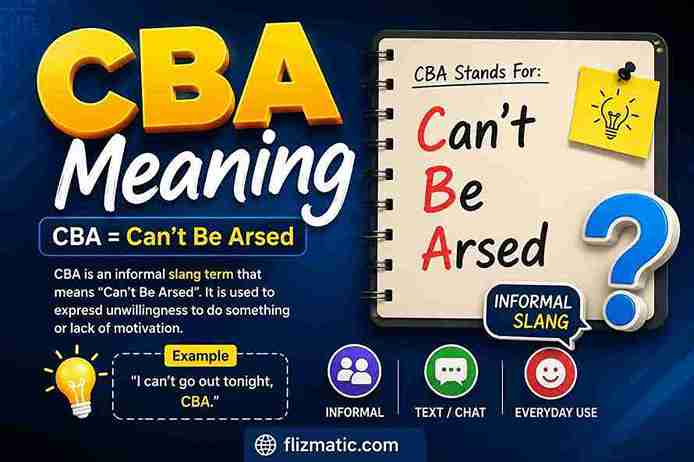
CBA Meaning: Complete Definitions, Slang & Business Examples
You see “CBA” in a text, a budget report, or a legal document—and your mind goes blank. A mistaken cba meaning can blow a business deal, cause awkward social gaffes, or lead to contract disputes. That tension is unnecessary. This guide lays out every common cba meaning with clear, no-jargon definitions and real-world scenarios you can apply right away.
CBA Meaning at a Glance: Quick Reference Table
Before diving deep, check the cba meaning you need from the table below. Each row links context to the exact definition.
| Acronym | Full Meaning | Context | Key Fact |
| CBA | Cost-Benefit Analysis | Business, Finance, Government | Weighs projected costs against benefits to decide if a project is worthwhile. |
| CBA | Can’t Be Arsed | Texting, Slang, Social Media | British expression for lack of motivation; equivalent to “I can’t be bothered.” |
| CBA | Collective Bargaining Agreement | Labor Relations, Employment | Legal contract between union and employer covering wages, hours, conditions. |
| CBA | Certified Bank Auditor | Banking, Accounting | Professional credential for auditors specializing in financial institutions. |
| CBA | Curriculum-Based Assessment | Education | Testing method that measures student proficiency directly from taught curriculum. |
| CBA | Community Benefits Agreement | Urban Development, Law | Legally binding pact ensuring local community gains from a development project. |
| CBA | Component-Based Architecture | Software Engineering | Software design approach where systems are built from reusable, independent components. |
| CBA | Continental Basketball Association | Sports, Basketball | Professional men’s basketball league that operated in the United States (1946–2009). |
| CBA | Cost-Benefit Analysis (Healthcare) | Medical, Health Economics | Evaluates treatment costs vs. health outcomes, such as quality-adjusted life years. |
CBA Meaning in Business and Finance: Cost-Benefit Analysis
In business, the most widespread cba meaning is Cost-Benefit Analysis. It’s a structured process that adds up the positive outcomes (benefits) of a decision and subtracts the associated costs. Decision-makers use it to find out if a project will deliver more value than it consumes.
A cost-benefit analysis often expresses everything in money terms. You list every possible cost—upfront investment, labor, maintenance, and opportunity costs. Then you list tangible benefits like revenue increases, cost savings, and intangible advantages like brand reputation or employee satisfaction. Subtract total costs from total benefits. A positive net result signals a green light.
Real-world example
A small bakery considers buying a new industrial oven for $20,000. The owner estimates the oven will increase production and bring in $35,000 extra profit over three years. A quick CBA shows a $15,000 net gain. That positive figure justifies the purchase.
| Cost item | Amount | Benefit item | Amount |
| Oven purchase & installation | $20,000 | Extra profit from higher output | $35,000 |
| Training staff | $1,000 | Reduced labor costs (automation) | $4,000 |
| Total costs | $21,000 | Total benefits | $39,000 |
| Net benefit | +$18,000 |
When you master this cba meaning, you equip yourself to defend budgets, pitch ideas, and kill weak projects early.
External source: Investopedia’s Cost-Benefit Analysis definition.
How to Perform a Cost-Benefit Analysis (Step-by-Step)
Before you apply this cba meaning to a real decision, walk through these five clear steps. The process takes complexity out of financial choices.
- Frame the decision. State exactly what you plan to do and define success.
- List every cost and benefit. Include direct, indirect, tangible, and intangible items. Don’t ignore soft factors like employee morale or customer trust.
- Assign a dollar value to each item. Use market prices, expert estimates, or historical data. For intangibles, apply conservative proxies.
- Discount future money to today’s value. A dollar earned three years from now is worth less than a dollar today. Apply a discount rate (often 5–10%) to future amounts.
- Compare net present value. Subtract total discounted costs from total discounted benefits. A positive number means the project adds value.
Most business analysts run a sensitivity check by tweaking the numbers. Even small changes in cost estimates should not flip the answer. That builds confidence in the cba meaning you rely on.
CBA Meaning in Texting and Social Media: Can’t Be Arsed
In digital chat, the cba meaning flips to casual slang. CBA stands for “Can’t Be Arsed,” a blunt way of saying you lack the energy or motivation to do something. It’s common in British English and has spread through global social media.
Example 1
Friend: “Fancy a 6 a.m. jog tomorrow?”
You: “CBA, let’s sleep in.”
Example 2
Colleague: “Did you finish the report?”
You: “No, I completely CBA yesterday. Doing it now.”
This cba meaning carries a lighthearted, sometimes lazy tone. You’ll see it in WhatsApp groups, TikTok captions, and Twitter replies. Avoid using it in formal emails or client communication.
External source: Cambridge Dictionary entry for “can’t be arsed.”
In labor relations, CBA stands for collective bargaining agreement. In terms of employment law, the CBA
In employment law, the cba meaning shifts to a binding contract. A Collective Bargaining Agreement is a written pact between an employer and a labor union that represents employees. It governs wages, working hours, benefits, safety conditions, and grievance procedures.
Union representatives and management negotiate the terms. Once both sides ratify the document, it becomes legally enforceable. The agreement typically lasts two to five years. Every worker covered by the CBA enjoys the same protections, even if they are not union members.
Key point: This cba meaning touches millions of workers in sectors like manufacturing, education, and public services. If you get a job covered by a collective bargaining agreement, your paycheck, overtime rules, and paid leave follow that contract.
Core Elements of a Collective Bargaining Agreement
Understanding this cba meaning requires knowing what’s inside the document. A strong CBA includes:
- Wages and pay scales: Hourly rates, annual increases, and shift differentials.
- Hours of work: Standard workweek, overtime thresholds, and break rules.
- Benefits: Health insurance, retirement plans, paid vacation, sick leave.
- Job security: Seniority rights, layoff procedures, and recall rights.
- Grievance and arbitration: Steps an employee follows to report unfair treatment and how disputes get resolved.
- Health and safety: Commitment to a safe workplace, often exceeding minimum legal standards.
- Management rights: Clauses that preserve the employer’s authority over business decisions.
When you read a union job posting, the phrase “covered by CBA” signals this exact cba meaning.
External source: U.S. Department of Labor page on collective bargaining.
CBA Meaning in Banking: Certified Bank Auditor
Banking professionals recognize another cba meaning: Certified Bank Auditor. This professional certification, offered by the American Bankers Association (ABA), validates an auditor’s skill in reviewing a bank’s internal controls, financial reporting, and regulatory compliance.
A Certified Bank Auditor ensures that a bank’s books are accurate and that the institution follows federal and state laws. Earning the credential requires passing a rigorous exam and meeting experience requirements. For community and regional banks, hiring a CBA-certified professional can strengthen trust with regulators and shareholders.
If you see “CBA” after a name on a bank’s leadership page, it points to this specialized cba meaning, not cost-benefit analysis or slang.
External source: American Bankers Association professional certifications.
CBA Meaning in Education: Curriculum-Based Assessment
For teachers and school administrators, the cba meaning refers to Curriculum-Based Assessment. This form of testing directly measures a student’s performance on the material taught in class. Instead of standardized, one-size-fits-all exams, CBA evaluates how well a child masters specific weekly or monthly learning targets.
A third-grade teacher might use a one-minute reading fluency probe, count the correct words per minute, and compare the result to grade-level expectations. The data drives instant instructional adjustments. Schools use CBA to identify struggling students early and to monitor the effectiveness of interventions.
This cba meaning puts the spotlight on growth, not just final exam scores. “What did the learner understand from what I taught?” is addressed.
CBA Meaning in Urban Development: Community Benefits Agreement
City planners and community activists often use the cba meaning of Community Benefits Agreement. This is a legally binding contract between a real estate developer and a coalition of neighborhood groups. In exchange for community support of a large project—like a stadium, shopping center, or housing complex—the developer promises concrete local benefits.
These promises might include a certain number of affordable housing units, local hiring targets, living-wage requirements, funding for parks, or contributions to public transit. The agreement has teeth; the community coalition can enforce it through the courts if the developer fails to deliver.
This cba meaning has reshaped development battles across cities like Los Angeles, Detroit, and New York. It shifts negotiations from protest to written obligation.
External source: HUD’s guide on community benefits agreements and equitable development.
CBA Meaning in Software Development: Component-Based Architecture
Software engineers give the cba meaning a technical twist: Component-Based Architecture. It’s a design philosophy that builds applications by snapping together independent, reusable pieces—components. Each component handles a specific function and communicates with others through well-defined interfaces.
A modern web app might have a login component, a search component, a payment component, and a notification component. Teams can develop, test, and update each piece in isolation. This speeds up delivery, lowers bug counts, and makes the system easier to scale.
If you overhear developers say, “We’re moving to a CBA approach,” they refer to this modular cba meaning, not a financial model.
CBA Meaning in Sports: Continental Basketball Association
Sports fans recognize a historic cba meaning: the Continental Basketball Association. This professional men’s league operated in the United States from 1946 to 2009. At its peak, the CBA served as a direct feeder to the NBA, with many players, coaches, and officials sharpening their skills there before advancing.
Notable alumni include NBA legends such as Phil Jackson and George Gervin. The league also introduced innovations like the three-point line before the NBA adopted them. Although the CBA ceased operations, its influence on basketball’s development remains significant. If you spot “CBA” in a vintage sports article, it carries this cba meaning.
CBA Meaning in Healthcare: Cost-Benefit Analysis for Clinical Decisions
In healthcare, the cba meaning of Cost-Benefit Analysis adapts to measure treatment value. Hospitals and policymakers compare the monetary cost of a therapy with the health outcomes it produces, often expressed in quality-adjusted life years (QALYs). One QALY equals one year of perfect health.
A health economist might calculate that a new cancer drug costs $150,000 per patient and adds 2.5 QALYs. The cost per QALY then determines whether a national health service will fund the drug. Most public health bodies set a threshold—often $50,000 to $100,000 per QALY—to decide.
This cba meaning ensures that limited health budgets go toward treatments that deliver the most real-world benefit. While ethical debates surround putting a price on life, the method brings transparency to tough allocation choices.
Frequently Asked Questions About CBA Meaning
What is the most common cba meaning in a business report?
In business, CBA stands for Cost-Benefit Analysis. It compares the expected costs of a project with the projected benefits to guide go/no-go decisions.
How do I use the slang cba meaning properly?
You use CBA in casual text chats and social media to mean “Can’t Be Arsed.” It expresses a lack of motivation or unwillingness to do something. Reserve it for informal, friendly conversations.
What cba meaning applies to a union job offer?
A union job offer that references “CBA” means Collective Bargaining Agreement. This contract details your pay, benefits, and working conditions, negotiated by the union.
Can CBA mean something in banking besides cost-benefit analysis?
Yes. In banking, CBA commonly stands for Certified Bank Auditor, a credential held by auditors who ensure a financial institution’s compliance and sound internal controls.
Is there a cba meaning in schools?
Educators use CBA for Curriculum-Based Assessment, a tool that measures how well a student masters the actual material taught in the classroom, rather than off-the-shelf standardized tests.
How do I figure out which cba meaning fits my document?
Look at the surrounding context. A financial projection likely refers to Cost-Benefit Analysis. A union notice points to a Collective Bargaining Agreement. A WhatsApp message signals “Can’t Be Arsed.” Match the environment, and the correct cba meaning becomes obvious.