Fashion Design: The Complete Guide to Turning Ideas into Style
Introduction
A sketch becomes a garment. A thought becomes a trend. Fashion design is the powerful engine driving the global apparel industry, merging art with engineering. If you have ever dreamed of seeing your creations on the runway or in stores, understanding the fundamentals is non-negotiable. This guide breaks down the exact process, required skills, and business strategies needed to navigate the competitive world of style. You will learn how to move from a blank page to a finished, wearable piece of art.
The Psychology of Fashion Design: Why We Wear What We Wear
Fashion design is not just about fabric; it is about communication. Every color, hemline, and texture sends a signal. Designers act as cultural translators, taking the abstract feelings of an era and turning them into tangible clothing.
Research from the Journal of Consumer Psychology indicates that clothing choices directly affect cognitive performance and confidence levels. When a designer creates a power suit, they are engineering a psychological state for the wearer. Understanding human behavior is the foundational layer of every great collection. You are solving a problem—the need for identity expression—through silhouette and stitch.
Core Elements of a Successful Fashion Design
Every garment, regardless of its complexity, relies on four pillars. If you master these elements, your work will stand out in a crowded market.
- Silhouette: The overall shape or outline of the garment. This is the first thing the eye sees from a distance.
- Line: The seams, pleats, and edges that guide the eye across the body. Lines create movement and structure.
- Color Theory: The strategic use of hue, saturation, and value to evoke emotion. A monochrome look feels distinct from a clashing pattern.
- Texture: The surface quality of the material. Mixing leather with silk creates tension and interest that flat designs lack.
The Step-by-Step Fashion Design Process
Creating a collection is a structured journey. Random inspiration rarely turns into a sellable product without a rigorous workflow. Follow this sequence to maintain consistency.
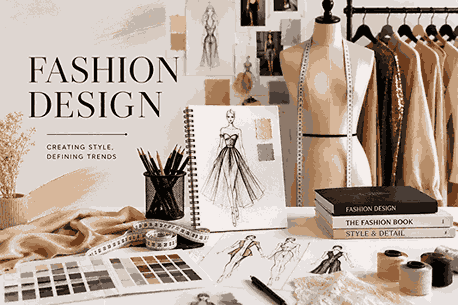
- Research and Mood Boarding: Gather images, historical references, and fabric swatches.
- Sketching and Illustration: Draw rough croquis (figure drawings) to visualize proportions.
- Fabric Sourcing: Select materials that drape, stretch, or hold structure according to your design.
- Pattern Making: Translate the 2D sketch into 3D shapes using paper or digital CAD software.
- Toile (Muslin) Creation: Sew a test garment in cheap fabric to check the fit.
- Construction: Sew the final garment with precise finishing techniques.
Essential Tools for Modern Designers
You do not need a massive studio to start, but you do need the right equipment. The industry has shifted toward digital, but tactile skills remain vital.
- Analog Tools: A reliable set of pencils (2H to 6B), a clear ruler, a French curve, and a dress form.
- Digital Tools: Adobe Illustrator for flat sketches and CLO 3D for virtual prototyping.
- Hardware: A high-quality sewing machine capable of handling multiple fabric weights and a serger for finishing edges.
Fashion Design vs. Fashion Styling: Understanding the Difference
Many confuse these two disciplines, but they serve distinct functions.
- Fashion Design is the creation of the garments themselves. It involves pattern making, construction, and manufacturing.
- Fashion Styling is the curation of existing garments to create a cohesive look for a photoshoot, celebrity, or editorial.
A designer builds the system; a stylist assembles the output. If you prefer building things with your hands, design is your lane.
Developing Your Signature Aesthetic
The market is saturated with generic clothing. To succeed, your fashion design must be recognizable. This requires a commitment to a specific point of view.
Look at designers like Rick Owens or Vera Wang. You can identify their work without seeing a label. This identity emerges from repetition. You must choose a specific color palette, a preferred silhouette, and a consistent material library. Your aesthetic is your brand’s fingerprint; it is the reason a customer chooses you over a fast-fashion giant.
Sustainability in Modern Fashion Design
The modern consumer demands responsibility. Sustainable fashion design is no longer a niche; it is a requirement for survival. The Ellen MacArthur Foundation highlights that the industry produces over 92 million tons of waste annually.
As a designer, you can combat this through:
- Zero-waste pattern cutting: Arranging pattern pieces like a puzzle to use 100% of the fabric.
- Upcycling: Deconstructing vintage garments to create new luxury pieces.
- Material Innovation: Sourcing organic cotton, Tencel, or recycled polyester.
How to Source Fabrics Like a Professional
The fabric is the soul of your design. A great sketch can fail with poor material, while a simple sketch can become art with luxury fabric.
Attend trade shows like Première Vision in Paris to see upcoming trends. For independent designers, local deadstock warehouses are goldmines. Deadstock is leftover fabric from major fashion houses. It is high quality, affordable, and eco-friendly. Always request a “s watch” (a small sample) before committing to a bulk order to test how it behaves under a sewing machine needle.
Understanding the Business Side of Design
Creativity without commerce is a hobby. To turn fashion design into a career, you must understand the financial model.
Calculate your Cost Per Garment (CPG) meticulously. If a dress costs $50 to produce (including labor and fabric), you must sell it for at least $200 to cover overheads and marketing. Understanding your target market’s price ceiling is crucial. A beautiful design that costs more than your audience can pay is a failed business venture, regardless of its artistic merit.
Building a Portfolio That Gets You Hired
Your portfolio is your resume. It should not be a scrapbook of everything you have ever made; it must be a curated presentation of your best work.
Focus on quality over quantity. Show three or four projects in depth rather than twenty superficial ones. Include your research pages, fabric swatches, flat sketches, and final editorial photos. According to hiring managers at The Business of Fashion, attention to detail in the process often matters more than the final look. It proves you can replicate the result commercially.
Navigating Fashion Trends in 2024 and Beyond
Trends cycle faster than ever. Relying solely on seasonal trends makes your work disposable. However, ignoring them entirely makes you irrelevant.
The key is to use trends as a seasoning, not the main course. The WGSN trend forecasting agency notes a shift toward “Quiet Luxury” and “Elevated Basics.” This means consumers are buying fewer, better items. Your fashion design should focus on longevity, durability, and subtle details that scream quality to those who know where to look.
Table: Essential Fabrics and Their Properties
| Fabric Type | Best Use | Difficulty Level | Sustainability Rating |
|---|---|---|---|
| Cotton Poplin | Shirts, Summer Dresses | Beginner | High (Organic) |
| Silk Charmeuse | Eveningwear, Lingerie | Expert | Medium |
| Denim | Trousers, Jackets | Intermediate | Low (Traditional) |
| Tencel/Lyocell | Draped Dresses, Trousers | Beginner | High |
| Wool Coating | Outerwear, Blazers | Advanced | High |
| Leather | Jackets, Accessories | Expert | Low (Vegan options High) |
Frequently Asked Questions (FAQs)
Question: What is the first step in the fashion design process?
Answer: The first step is always research. You must gather inspiration from art, history, architecture, or street style. This research forms the foundation of your mood board and dictates the color palette, fabric choices, and silhouette direction before you ever pick up a pencil.
Question: How do I start a fashion design career without a degree?
Answer: You can start by mastering the core technical skills—sewing and pattern making—through online courses or apprenticeships. Build a strong portfolio and network aggressively. Many brands value a stunning portfolio and raw skill over formal education.
Question: What is the difference between a fashion designer and a pattern maker?
Answer: A fashion designer conceptualizes the idea and sketches the look. A pattern maker is a technical specialist who translates that sketch into the precise geometric shapes needed to cut fabric. Often, one person does both, but in large houses, these are distinct jobs.
Question: Which software is best for digital fashion design?
Answer: Adobe Illustrator is the industry standard for creating “flats” (technical drawings). However, CLO 3D is becoming essential for 3D visualization. CLO allows you to simulate the drape of fabric on a virtual avatar without sewing a physical sample.
Question: How much does it cost to start a fashion design business?
Answer: Costs vary wildly, but a small independent line can start with a budget of $5,000 to $10,000. This covers a domain, basic equipment, fabric, and a small production run. It does not include large-scale marketing or hiring staff.
Question: Why is a “toile” or muslin important in garment creation?
Answer: A toile is a test version of your garment made from cheap fabric. It is critical because it allows you to fix the fit on a real body before you cut into expensive silk or wool. It saves time, money, and heartbreak in the final construction.
Conclusion
The world of fashion design is demanding, but the reward of seeing a person walk down the street wearing your creation is unmatched. You now have the roadmap—from the initial spark of research to the technical constraints of fabric sourcing and the reality of business margins. Stop waiting for the perfect moment. Pick up a pencil, thread a needle, and start sketching your future today. Your first collection is waiting to be made.