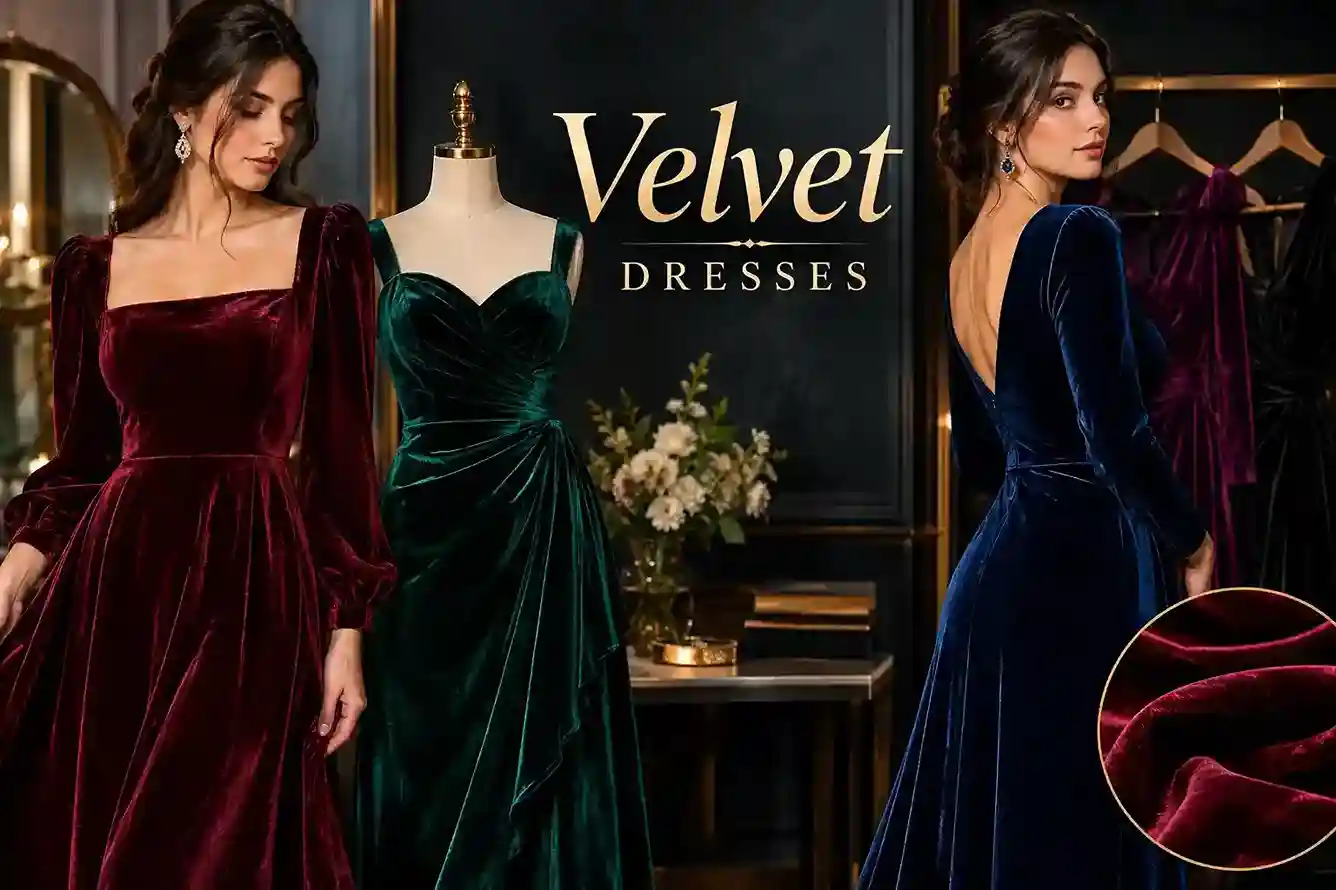
What Are Velvet Dresses? A Comprehensive Guide to Selecting, Styling, and Maintaining Them
You found the perfect velvet dress online. It arrives, and the pile looks flat, the fit pulls, and one wrong hang has left a crease. Velvet punishes guesswork. This guide fixes that. You will learn how to pick the right fabric, find your fit, style each piece, and care for it so it looks rich for years.
What Are Velvet Dresses and Why Do They Stand Out?
Velvet dresses are garments cut from a woven fabric with a short, dense pile on one side. That pile catches light and gives the cloth its soft touch and deep color. Few fabrics look this rich under evening light.
Velvet comes from a special weave, not a single fiber. Makers can produce it from silk, cotton, rayon, or polyester. The fiber changes the drape, price, and care.
| Feature | What It Means for You |
|---|---|
| Pile | Creates the soft feel and deep color |
| Nap | The direction the pile lies; it changes how color looks |
| Weight | Heavier velvet drapes; lighter velvet flows |
| Fiber | Decides cost, breathability, and care |
Where Did Velvet Come From?
Velvet has a long luxury record. Weavers in Italian cities such as Genoa, Venice, and Florence made it a prized cloth by the Renaissance. Royal courts and wealthy families wore it as a sign of status.
Industrial looms later brought velvet to more people. Today you can find it at every price. The textile collection of the V&A Museum uses surviving clothing and textiles to record this history.
| Era | Role of Velvet |
|---|---|
| Medieval and Renaissance | Status cloth for courts and clergy |
| 19th century | Spread through mechanized weaving |
| Today | Everyday and occasion wear at all price points |
Which Velvet Fabric Types Should You Know?
The fabric name on the label tells you how the dress will behave. Prior to checking the color, inspect it.
- Silk velvet: Light, fluid, and luxurious. It costs more and needs dry cleaning.
- Cotton velvet: Matte and sturdy. It suits structured cuts.
- Rayon (viscose) velvet: Soft with a nice drape, often blended with silk.
- Polyester velvet: Affordable and resilient, but less breathable.
- Stretch velvet: Includes elastane for comfort and a close fit.
- Crushed velvet: Twisted while damp to create a rippled, shimmering look.
| Type | Drape | Breathability | Care Level | Best For |
|---|---|---|---|---|
| Silk velvet | Fluid | High | High | Formal events |
| Cotton velvet | Structured | Medium | Medium | Daytime and cooler months |
| Rayon velvet | Soft | Medium | Medium | Cocktail wear |
| Polyester velvet | Medium | Low | Low | Budget and travel |
| Stretch velvet | Body-skimming | Medium | Low to medium | Bodycon and wrap styles |
| Crushed velvet | Textured | Medium | Medium | Statement looks |
Fiber content must appear on the label in the United States, so use it. The Federal Trade Commission explains these labeling rules for textile products (FTC).
Which Styles of Velvet Dresses Can You Choose From?
Cut matters as much as cloth. The same velvet reads very differently in a slip than in a wrap.
- Velvet midi dress: Hits mid-calf. It works for dinners and weddings.
- Velvet maxi dress: Floor length with strong drama for formal nights.
- Mini velvet dress: Short and playful for parties.
- Wrap velvet dress: Adjusts to many body shapes.
- Slip velvet dress: Minimal and sleek with thin straps.
- Long-sleeve velvet dress: Warm and elegant for winter.
| Style | Formality | Best Season | Easy to Layer? |
|---|---|---|---|
| Mini | Casual to semi-formal | Autumn, winter | Yes |
| Midi | Semi-formal | Autumn, winter, spring | Yes |
| Maxi | Formal | Winter | Yes |
| Wrap | Flexible | Autumn, winter | Yes |
| Slip | Semi-formal | Year-round with layers | Yes |
| Long-sleeve | Flexible | Winter | Limited |
How Do You Find the Right Fit and Silhouette?
Velvet shows every seam and tug. A good fit lets the fabric hang cleanly.
- Pear shape: Choose A-line or wrap cuts to balance proportions.
- Apple shape: Try an empire waist or V-neck for easy flow.
- Hourglass: Wrap and fitted styles follow your curves.
- Rectangle: Ruching, belts, or peplum add shape.
- Petite: Pick a midi or mini and avoid heavy volume.
- Tall: A velvet maxi dress shows off your length.
Always sit, raise your arms, and walk when you try one on. Velvet that pulls across the bust or hips will mark and wear fast.
| Body Shape | Cut to Try | Detail to Look For |
|---|---|---|
| Pear | A-line, wrap | Interest at the neckline |
| Apple | Empire, V-neck | Soft drape over the middle |
| Hourglass | Wrap, fitted | Defined waist |
| Rectangle | Peplum, ruched | Belt or cinched waist |
| Petite | Midi, mini | Vertical lines |
| Tall | Maxi, long sleeve | Full skirt |
Which Colors Work Best for Velvet Dresses?
Velvet deepens color, so rich shades look especially good. A black velvet dress is the safest start because it suits almost every event.
- Black: Classic and flexible.
- Emerald and forest green: Bold and festive.
- Burgundy and wine: Warm and elegant.
- Navy: Refined and easier to wear than black for many skin tones.
- Dusty rose and blush: Soft and romantic.
- Jewel tones (sapphire, amethyst): Strong evening impact.
| Color | Mood | Pairs With |
|---|---|---|
| Black | Timeless | Gold, silver, any shoe |
| Emerald | Rich | Gold, nude, black |
| Burgundy | Warm | Gold, tan, black |
| Navy | Calm | Silver, camel, white |
| Blush | Soft | Gold, ivory, grey |
When Should You Wear Velvet Dresses?
Velvet suits cool weather and evening light. Match the style to the event, and you will always look fitting.
- Weddings (as a guest): A midi or maxi in a jewel tone.
- Holiday parties: Burgundy, green, or black.
- Date nights: A slip or wrap style.
- Office events: A long-sleeve knee-length cut.
- Winter formals: A floor-length gown.
| Occasion | Recommended Style | Color Idea |
|---|---|---|
| Wedding guest | Midi or maxi | Emerald, navy |
| Holiday party | Mini or midi | Burgundy, black |
| Date night | Slip or wrap | Wine, blush |
| Work event | Long-sleeve knee length | Navy, black |
| Formal gala | Maxi | Jewel tones |
How Do You Style a Velvet Dress?
Velvet already has texture, so keep the rest simple. Let the dress lead and use one or two accessories.
If you wonder how to style a velvet dress for daytime, pair it with boots and a denim or leather jacket. That mix relaxes the fabric. For evening, add heels and a small clutch.
- Jewelry: Choose either a statement necklace or statement earrings, not both.
- Shoes: Heels for evening, ankle boots for day.
- Outerwear: A tailored coat, a leather jacket, or a faux-fur wrap.
- Tights: Sheer black adds warmth without competing.
- Hair: Sleek styles keep the focus on the neckline.
| Look | Shoes | Layer | Accessory |
|---|---|---|---|
| Evening | Heels | Wool coat | Clutch |
| Daytime | Ankle boots | Denim jacket | Scarf |
| Office | Block heels | Blazer | Simple studs |
| Casual | Sneakers | Cardigan | Crossbody |
9. How Do You Care for Velvet Dresses?
Learning how to care for velvet protects your investment. Start with the care label. Federal rules require clothing to carry care instructions, so trust the label first (FTC Care Labeling Rule).
- Silk and rayon velvet: Dry clean only.
- Hang with room: Crowding crushes the pile.
- Steam, don’t iron: Hold a steamer a few inches away from the fabric.
- Brush gently: Use a soft brush in the direction of the nap.
- Spot clean fast: Blot with a clean cloth. Do not rub.
- Store correctly: Use a breathable garment bag, not plastic.
| Problem | What to Do | What to Avoid |
|---|---|---|
| Wrinkles | Steam from a short distance | Pressing with a hot iron |
| Crushed pile | Steam, then brush gently | Rubbing hard |
| Small spill | Blot right away | Scrubbing |
| Odor | Air outside, in shade | Heavy perfume sprays |
| Storage | Hang in breathable cover | Tight folds |
How Do You Spot Quality Before Buying?
A well-made velvet dress feels different in your hands. Take a minute to check a few details.
- Run your hand both ways: The pile should feel even and not patchy.
- Check the seams: Look for flat, tidy stitching with no puckering.
- Look at the lining: A good lining prevents cling and wear.
- Test the stretch: Stretch velvet should bounce back.
- Read the label: Confirm fiber content and care.
| Quality Check | Good Sign | Warning Sign |
|---|---|---|
| Pile | Dense, even | Thin, bald spots |
| Seams | Flat, strong | Puckered, loose threads |
| Lining | Smooth, full | Missing or scratchy |
| Color | Uniform | Streaky |
| Zipper | Smooth, hidden | Catches the fabric |
What Should You Budget for Velvet Dresses?
Price follows fiber, construction, and brand. Prices vary by market and season, so treat these tiers as a general guide.
- Budget: Usually polyester or blends. Good for trying a trend.
- Mid-range: Better finishing and more rayon or cotton.
- Premium: Silk velvet or designer tailoring.
Cost per wear is a smarter measure. A mid-priced velvet dress worn eight times often beats a cheap one worn once.
| Tier | Typical Fabric | Expected Lifespan | Best For |
|---|---|---|---|
| Budget | Polyester | Shorter | Trend testing |
| Mid-range | Rayon, cotton blends | Medium | Regular wear |
| Premium | Silk, silk blends | Long with care | Key occasions |
Which Mistakes Should You Avoid With Velvet Dresses?
Most velvet problems come from small habits. Fix these, and the dress lasts longer.
- Pressing a hot iron straight onto the pile
- Stuffing velvet into a packed closet
- Choosing a size too tight
- Wearing velvet in a hot, crowded room without breathable layers
- Skipping the care label
| Mistake | Result | Fix |
|---|---|---|
| Direct ironing | Flattened pile | Steam instead |
| Crowded closet | Creases and crush marks | Give it space |
| Tight fit | Pulling and wear | Size for comfort |
| Plastic cover | Trapped moisture | Use a breathable bag |
Your Next Step
Pick one occasion this season and choose the cut, color, and fabric that match it. Check the label, try it with a full range of movement, and follow the care steps above. Have a question about velvet dresses? Leave it in the comments, and we will answer it.