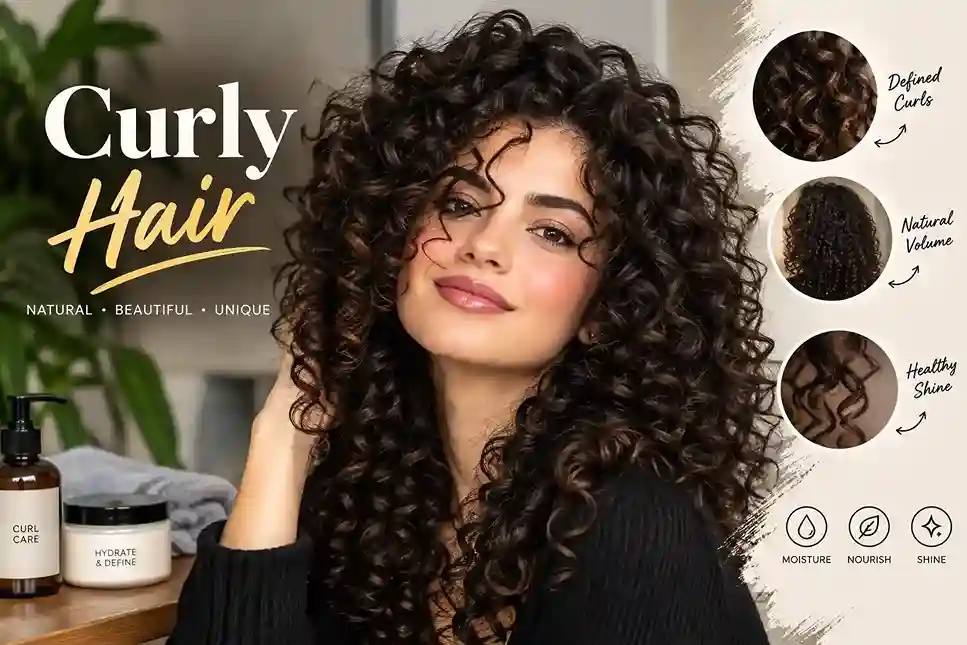
The Complete Curly Hair Care Guide: Types, Routines & Styling Tips That Actually Work
Your curls look incredible one day and completely unmanageable the next. You buy expensive products, follow trending routines, and still wake up to a tangled, frizzy mess. The frustration is real, and you deserve answers that go beyond surface-level advice. This guide breaks down everything about curly hair — from identifying your exact curl pattern to building a wash-day routine that delivers consistent, defined results every single week.
What Makes Curly Hair Behave Differently From Straight Hair?
Every strand of hair grows from a follicle beneath your scalp. Straight hair grows from round follicles. Curls grow from oval or flat-shaped follicles. This structural difference changes everything — how moisture travels down the shaft, how sebum coats each strand, and how easily breakage occurs.
The American Academy of Dermatology confirms that the curved shape of the follicle directly determines curl tightness and texture (aad.org). Because natural oils struggle to travel down a spiraled shaft, curls dry out faster than straight hair. This single fact explains why moisture sits at the center of every effective curly hair routine.
Curls also experience more friction between strands. That friction creates tangles, knots, and the frizz you fight daily. Understanding this biology removes the guesswork and helps you choose products that actually match your hair’s needs.
The Four Main Curly Hair Types Explained
The Andre Walker Hair Typing System classifies curls into four broad categories. Each category contains sub-types that describe tightness and diameter.
| Type | Name | Shape | Texture Feel | Moisture Need |
| Type 2 | Wavy | Loose “S” shape | Fine to medium | Low to moderate |
| Type 3A | Loose Curls | Large, springy loops | Medium | Moderate |
| Type 3B | Medium Curls | Tighter corkscrews | Medium to coarse | High |
| Type 3C | Tight Curls | Pencil-width spirals | Coarse | Very high |
| Type 4A | Coily | Defined “S” coils | Coarse | Very high |
| Type 4B | Z-Pattern Coils | Sharp angles | Very coarse | Maximum |
| Type 4C | Dense Coils | Tight zigzags, minimal definition | Extremely coarse | Maximum |
Type 2 hair sits on the border between straight and curly. Type 3 covers the classic ringlet shapes most people picture when they think of curls. Type 4 represents the tightest coil patterns, common among people of African descent. A peer-reviewed study published in the International Journal of Trichology notes that Type 4 hair has the highest fragility rate due to its elliptical cross-section and frequent twist points along each strand.
Most people carry a combination of two or even three types across different areas of their head. Your nape might hold tighter coils while your crown shows looser waves. Mapping your head section by section gives you the most accurate picture.
How to Identify Your Exact Curl Pattern at Home
Wash your hair with a gentle, sulfate-free shampoo. Skip conditioner for this test. Let your hair air-dry completely without touching it.
Once dry, examine a single strand. Does it form a loose wave, a springy ringlet, or a tight coil? Compare it against the chart above. Repeat this on three different sections — front, crown, and nape.
Building a Daily Curly Hair Routine From Scratch
A solid curly hair routine follows a simple order: cleanse, condition, style, protect. The specific products change based on your type, but the sequence stays the same.
Morning Refresh (5–10 minutes):
- Mist curls with water or a water-based leave-in spray
- Scrunch gently to reactivate yesterday’s product cast
- Apply a pea-sized amount of curl cream to frizzy spots
- Air-dry or diffuse on low heat for two minutes
Night Protection:
- Gather hair into a loose pineapple ponytail on top of your head
- Sleep on a satin or silk pillowcase
- Alternatively, wrap hair in a satin bonnet
This two-part routine preserves curl definition for two to three days between wash sessions. Consistency matters more than product quantity.
Best Curly Hair Products by Category
Choosing the right products eliminates trial-and-error spending. Here is a breakdown organized by function.
| Category | Purpose | Key Ingredients to Look For | Ingredients to Avoid |
| Sulfate-Free Shampoo | Gentle cleansing | Cocamidopropyl betaine, aloe vera | Sodium lauryl sulfate, sodium laureth sulfate |
| Deep Conditioner | Intense hydration | Shea butter, glycerin, hydrolyzed protein | Silicones (dimethicone), mineral oil |
| Leave-In Conditioner | Daily moisture | Argan oil, panthenol, marshmallow root | Alcohol denat, heavy waxes |
| Curl Gel | Hold and definition | Flaxseed, pvp, agave nectar | Drying alcohols, parabens |
| Curl Cream | Soft hold + moisture | Coconut oil, jojoba oil, honey | Petroleum, synthetic fragrance |
| Oil Sealant | Lock in hydration | Grapeseed oil, castor oil, sweet almond | Mineral oil, lanolin (for low porosity) |
A study from the National Institutes of Health highlights that glycerin-based formulations significantly improve moisture retention in textured hair when ambient humidity stays above 40% (pubmed.ncbi.nlm.nih.gov). In dry climates, glycerin can pull moisture out of the hair, so adjust based on your local weather.
Curly Hair Wash Day: A Step-by-Step Breakdown
Wash day is the foundation of healthy curls. Rushing through it creates problems that last all week.
- Pre-poo (optional): Apply coconut oil or olive oil to dry hair 30 minutes before washing. This protects strands from stripping during shampooing.
- Cleanse: Section hair into four parts. Massage sulfate-free shampoo into the scalp using your fingertips, not your nails. Rinse thoroughly.
- Condition: Apply a generous amount of conditioner from mid-length to ends. Detangle with a wide-tooth comb or your fingers while the conditioner sits. Leave it on for 5–10 minutes.
- Rinse with cool water: Cold water closes the cuticle and locks in moisture.
- Style on soaking wet hair: Apply leave-in conditioner, then curl cream, then gel — in that order. Use the “praying hands” method to distribute evenly.
- Dry: Plop with a microfiber towel for 20 minutes, then air-dry or diffuse.
How Porosity Affects Your Curly Hair Care
Porosity describes how easily your hair absorbs and retains moisture. It matters just as much as curl type.
| Porosity Level | Cuticle State | Absorption Speed | Moisture Retention | Best Approach |
| Low | Tightly closed | Slow | High once saturated | Use heat during deep conditioning; avoid heavy butters |
| Medium | Slightly open | Moderate | Balanced | Maintain with regular protein-moisture balance |
| High | Widely open | Fast | Low — loses moisture quickly | Layer leave-in, cream, and oil (LCO method); add protein treatments |
Quick at-home test: Drop a clean strand of hair into a glass of room-temperature water. If it floats for several minutes, you have low porosity. If it sinks immediately, you have high porosity. If it hovers in the middle, your porosity is medium.
High-porosity curls often result from chemical processing, heat damage, or environmental exposure. Low-porosity hair is typically genetic and resists product absorption until heat opens the cuticle.
Curly Hair Styling Techniques for Every Occasion
Different situations call for different styling methods. Here are the most effective techniques ranked by hold strength.
- Finger Coiling: Wrap small sections around your finger for uniform ringlets. Best for Type 3B–4A hair. Provides strong definition with medium hold.
- Shingling: Apply gel to individual sections and smooth downward. Creates maximum definition for Type 4 hair. Time-intensive but long-lasting.
- Plopping: Wrap wet, product-loaded hair in a cotton T-shirt or microfiber towel. Encourages curl formation at the roots while reducing frizz.
- Diffusing: Use a hair dryer with a diffuser attachment on low heat and low speed. Hover the diffuser around your head first, then cup sections into the bowl. Adds volume and speeds up drying.
- Twist-Outs and Braid-Outs: Twist or braid damp hair, let it dry completely, then unravel for a stretched, wavy-curl hybrid look. Works beautifully on Type 3C–4C hair.
- Wash-and-Go: Apply products to soaking wet hair and let it air-dry untouched. The fastest method, ideal for Type 2–3A curls.
Six Common Curly Hair Mistakes and How to Fix Them
1. Brushing dry curls. Dry brushing shatters curl clumps and creates instant frizz. Always detangle when hair is wet and coated with conditioner.
2. Using terry cloth towels. Regular bath towels rough up the cuticle. Switch to a microfiber towel or an old cotton T-shirt.
3. Skipping deep conditioning. Curls need intense hydration at least once a week. A 20-minute deep conditioning session prevents chronic dryness and breakage.
4. Applying products to dry hair. Most styling products distribute unevenly on dry strands. Apply to soaking wet hair for uniform coverage and better clumping.
5. Over-washing. Washing daily strips natural oils. Most curl types thrive on a 2–3 wash-per-week schedule.
6. Ignoring protein needs. Curls need protein to maintain structure. If your hair feels mushy or stretches without bouncing back, add a protein treatment every 4–6 weeks.
Curly Hair Nutrition: Foods That Strengthen Your Curls
Your diet directly impacts curl health. Hair is made of keratin, a protein, so protein intake matters.
- Eggs: Rich in biotin and complete protein. Supports keratin production.
- Salmon: Packed with omega-3 fatty acids that nourish the scalp and reduce inflammation.
- Spinach: Loaded with iron, folate, and vitamins A and C. Iron deficiency is a leading cause of hair thinning.
- Sweet potatoes: High in beta-carotene, which your body converts to vitamin A. Vitamin A stimulates sebum production for natural scalp moisture.
- Avocados: Provide vitamin E and healthy fats that protect hair from oxidative stress.
- Walnuts: Contain zinc, selenium, and omega-3s. Zinc deficiency links directly to hair shedding.
Drink at least eight glasses of water daily. Dehydrated bodies produce dry, brittle curls regardless of how many products you apply.
Seasonal Curly Hair Care Adjustments
Summer:
- Humidity increases frizz. Switch to a stronger-hold gel.
- UV rays damage the cuticle. Wear a hat or use a UV-protectant spray.
- Chlorine and salt water strip moisture. Pre-soak hair with fresh water and conditioner before swimming.
- Wash more frequently if sweat buildup irritates your scalp.
Winter:
- Cold air and indoor heating dry out curls rapidly. Increase deep conditioning to twice a week.
- Swap lightweight lotions for heavier creams and butters.
- Wear satin-lined hats instead of wool beanies, which cause friction and breakage.
- Reduce heat styling to prevent compounding dryness.
Curly Hair Myths Busted by Trichologists
Myth: Curly hair grows slower than straight hair.
Truth: All hair grows at roughly the same rate — about half an inch per month. Curls appear shorter because the spiral shape compresses visible length. This phenomenon is called shrinkage, and it can hide up to 75% of your actual hair length.
Myth: You should never use shampoo on curls.
Truth: Co-washing (conditioner-only washing) works for some curl types but leaves others with scalp buildup. A gentle, sulfate-free shampoo used once a week keeps follicles clean without stripping moisture.
Myth: Cutting curly hair makes it grow faster.
Truth: Trimming removes split ends and prevents breakage from traveling up the shaft. This preserves length but does not accelerate growth from the follicle.
Myth: All silicones are bad for curly hair.
Truth: Water-soluble silicones like amodimethicone wash out easily and provide slip without heavy buildup. Non-soluble silicones like dimethicone require sulfate shampoos for removal, which creates a damaging cycle for many curl types.
Take Control of Your Curls Today
Your curls are not a problem to solve. They are a texture to understand. Once you identify your curl type, porosity level, and moisture needs, every product choice and styling decision becomes simpler. Start with one change this week — swap your bath towel for a microfiber one, add a deep conditioning session to your Sunday, or finally ditch that sulfate shampoo sitting on your shelf. Small shifts compound into dramatic results over a few months. Your healthiest curls are not behind a paywall or hidden inside a miracle product. They are waiting for you to give them the consistent, informed care they deserve.